
The SIDur PGR Symposium
The SIDur PGR Symposium
The SIDur PGR Symposium is a termly research seminar for PGR students, organised by the SIDur Exec. It provides a forum for PGR students whose work includes an aspect of pure, applied or industrial mathematics. Any PGR student at Durham whose work fits this bill is welcome to present at the symposium.
The next SIDur Symposium will be held on Tuesday, February 17th 2026 in MCS1022.
Previous Talks
17 Feb 2026
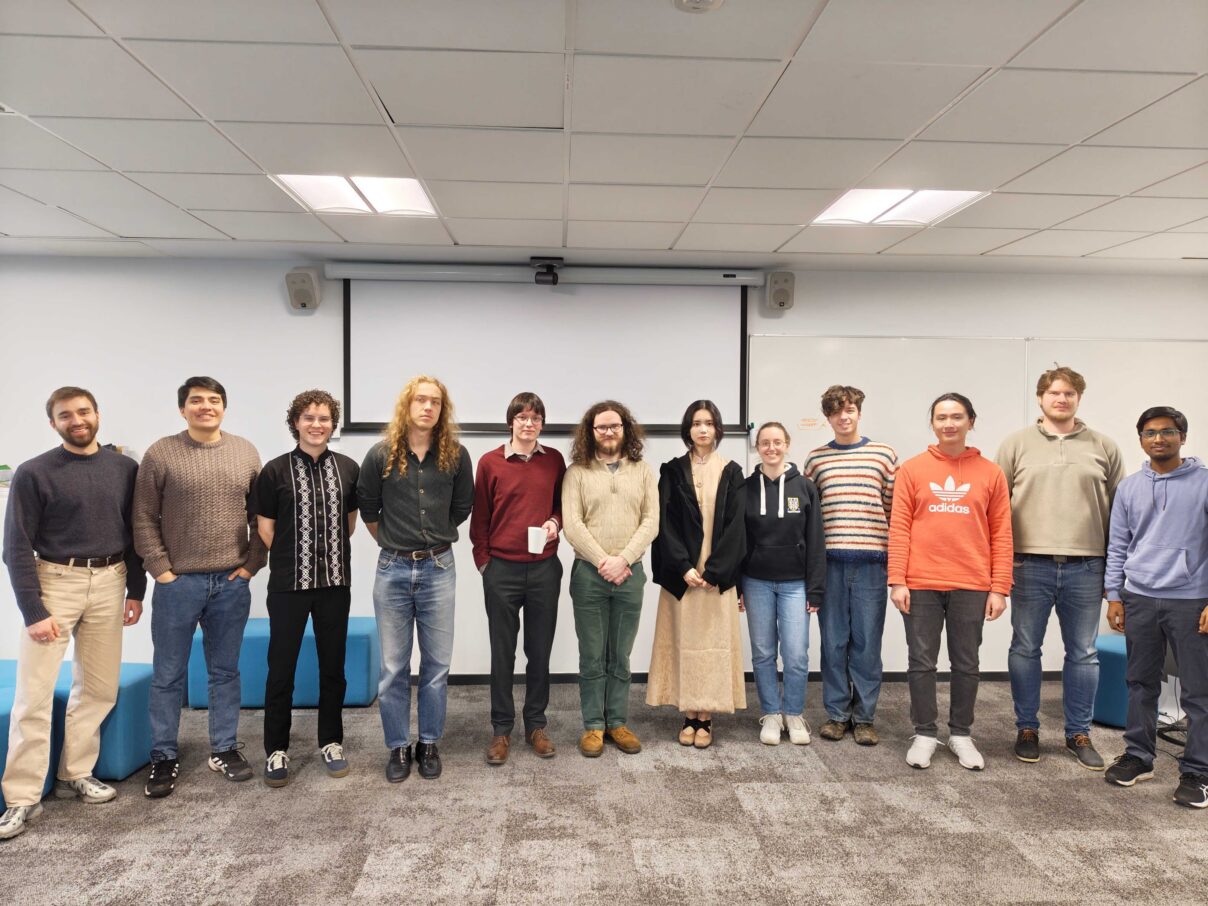
- Andreo Chimal: Wind farm wake modelling:from linearising equations to avoiding ‘wind theft’
- Guy Parker: A ferociously brief history of optimal transport
- Samuel Shepherd: From Sums of Squares to Theta Series
- Oscar Humphreys: Gaussian Processes for Probabilistic Seismic Wavefield Simulation
- Charlie Hall: Convex Hulls of Stochastic Processes
- Paraskevi Katsiavria: Heat transport in rotating, sheared convection
- Patrick Creagh: An Introduction to the Langlands Program
- Pawel Radtke: Understanding GPUs by Forgetting They’re Special
7 Feb 2025
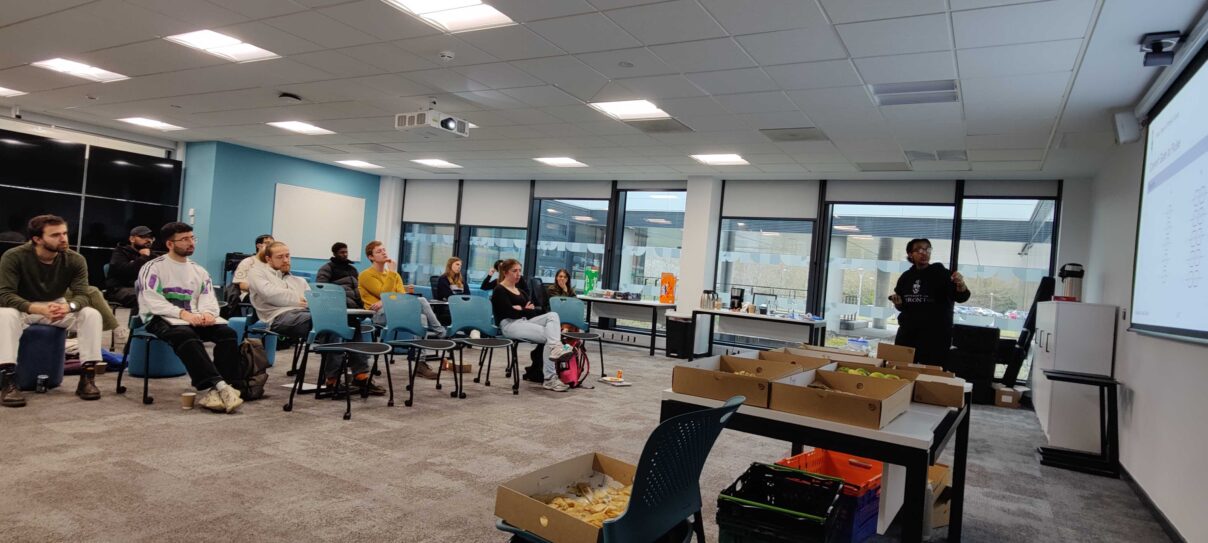
- Nick Chancellor (Newcastle School of Computing, AMBER): Challenges of making quantum computing a reality
- David Lanners (Durham Maths, Pure Group): Leveraging Rust’s Type System for Safe and Efficient Metropolis Simulations
- Zhaocheng Li (Durham Maths, Statistics in Uncertainty Quantification): The Surrogate Methodology for Computationally Intensive Models
- Luci Mullen (Durham Maths, Applied Maths): Nonlinear analysis of the Keller–Segel system with logistic growth
- Kaalkidan Sahele (Durham CompSci + Matter Systems Research Group, University of Toronto): Pulse Based Implementations of Encoder Circuits in Quantum Machine Learning
- Mukthar Opeyemi Mahmud (Geophysics, EarthSafe): Seismic Super-resolution Leveraging Machine Learning Techniques
- Chung Ming Loi (Durham CompSci, SciComp): Scalable non-intrusive UQ workflows in HPC environments
11 Oct 2024
- Edward Zhi (Mathematics, Probability): Why Is It Impossible to Stand a Pencil with Tip Down?
- Yueming Sun (Computer Science, Hybrid Intelligence Lab): Optimizing Autonomous Driving Systems through a Closed Data Loop: Advanced Pre-Annotation Tools Bridging Research and Industry
- David Kutner (Computer Science, ACiD/NESTID): Reconfigurable Routing in Data Centre Networks
- Tom E (Computer Science, ViViD): Dur360BEV: A Real-world Single 360 Camera Dataset and Benchmark for Bird-Eye View Mapping in Autonomous Driving
- Pawel Radtke (Computer Science, VIViD): Floating point compression meets Array of Structures to Structure of Array transformations – combining new language-level optimisations of SPH kernels
- Adam Tuft (Computer Science, Scientific Computing): Detrimental Task Execution Patterns in Mainstream OpenMP Runtimes
- Amber Chang (Computer Science, MiSCADA): Acceleration of Uncertainty Quantification on Parallel Systems
24 May 2024
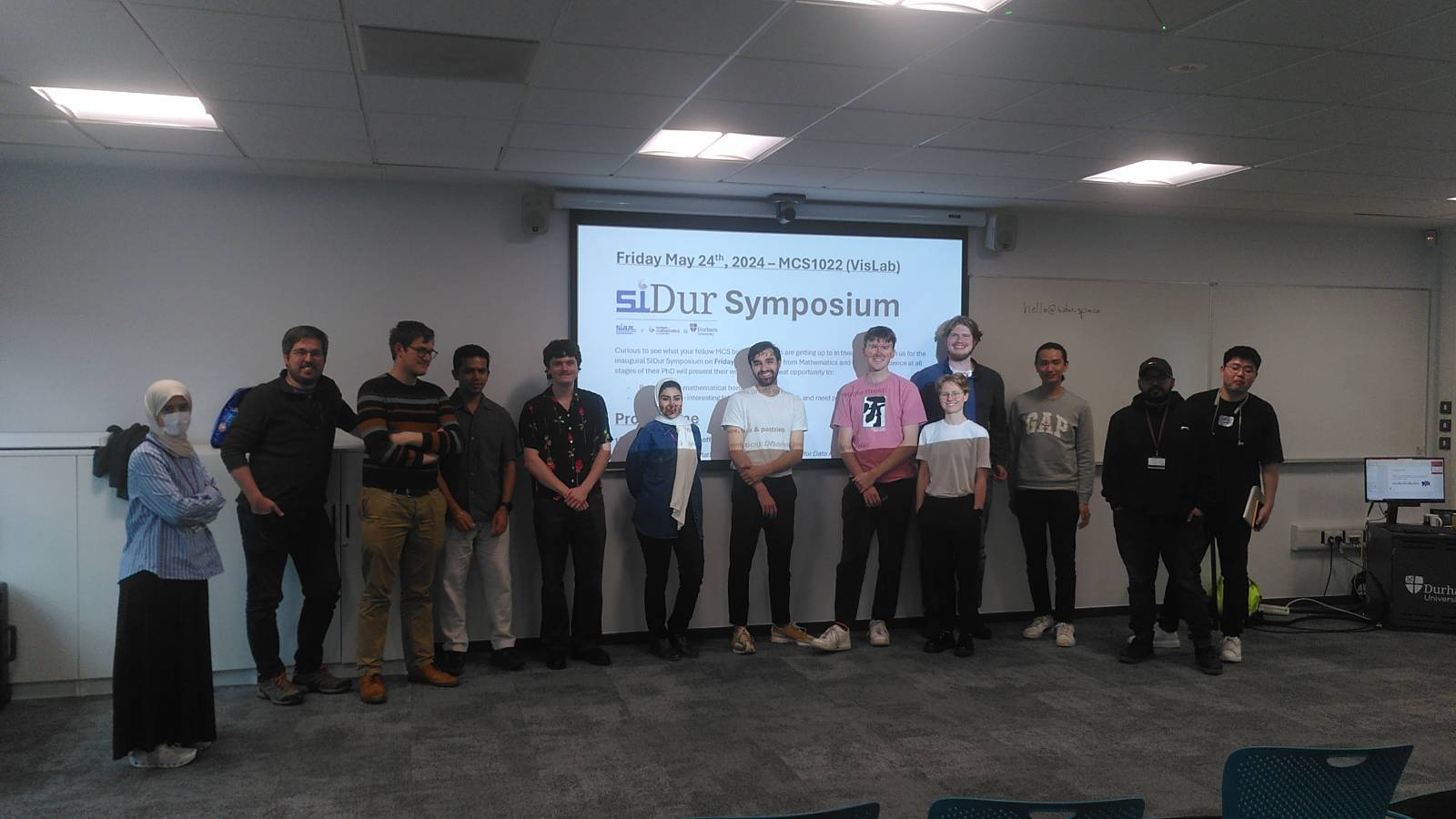
- Iolo Jones (Mathematics): Diffusion Geometry for Data Analysis
- Strahinja Klem (Computer Science, VIViD): LLMs for LLMs: Summarising Long Legal Documents via Prompt Engineering
- Tala Eagling-Vose (Computer Science, ACiD): Graph Homomorphisms, Colouring Games, and Forbidden Subgraphs
- Jost Pieper (Mathematics, Probability): Rough paths, sewing and rough stochastic calculus
- Thomas Hudson (Computer Science, VIViD): Why is Fido ill? Using LLMs to explore veterinary conversations
- Mohammed Alshammari (Computer Science, AIHS): Developing a Large Language Model for Enhanced Reliability and Transparency in Healthcare AI Systems
- Arron Bale (Mathematics): Carbonara – Predicting protein tertiary structure from BioSAXs data
- Maha Alsayyari (Computer Science, VIViD): Automatic Detection and Classification of Aortic Dissection based on CTA